
Plumbing fittings connect, redirect, control, and seal pipes in water supply and drainage systems. Common types include elbows, tees, couplings, reducers, unions, and valves. In Malaysia, the right fitting should match the pipe material, pressure, temperature, and climate conditions.
PVC is widely used for drainage, while PPR, CPVC, and copper are common for water supply. Fittings should also meet relevant Malaysian standards and certification requirements, such as SIRIM, to help prevent leaks, corrosion, and system failures.
Table of Contents
- What Are Plumbing Fittings?
- Why Fitting Selection Matters in Malaysia’s Climate
- Common Pipe Materials Used in Malaysian Plumbing
- Essential Types of Plumbing Fittings
- Fittings for Water Supply vs. Drainage Systems
- Compliance Standards for Fittings in Malaysia
- Choosing the Right Fitting for Your Project
- Common Installation Mistakes to Avoid
- FAQ
What Are Plumbing Fittings?
Plumbing fittings are components that connect, control, or redirect the flow of water within a piping system. They join pipe sections, change flow direction, regulate pressure, and seal connections against leaks.
In Malaysian construction, fittings must suit both potable water supply lines and wastewater drainage systems, each with different pressure and material requirements.
Why Fitting Selection Matters in Malaysia’s Climate
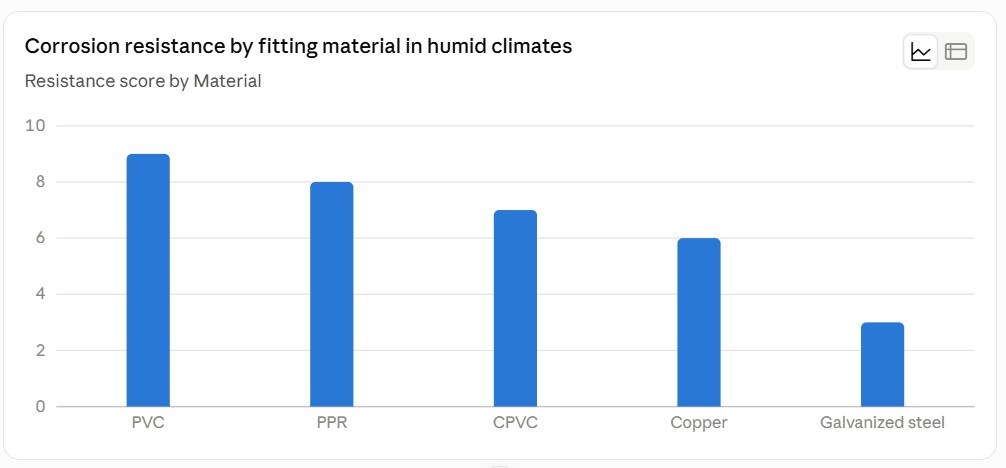
Malaysia’s high humidity, heavy monsoon rainfall, and consistently warm temperatures accelerate corrosion in metal fittings and can cause thermal expansion in exposed pipework. Poorly matched fittings are a leading cause of leaks in older shophouses and high-rise developments alike.
Key climate-related risk factors include:
- Corrosion acceleration from humidity in coastal and urban areas
- UV degradation of exposed PVC fittings on rooftops and external risers
- Pressure fluctuations during monsoon season affecting municipal supply
- Biofilm buildup in stagnant sections of poorly designed fitting layouts
Common Pipe Materials Used in Malaysian Plumbing
Different fittings are engineered to match specific pipe materials, since mismatched materials cause galvanic corrosion or poor seals.
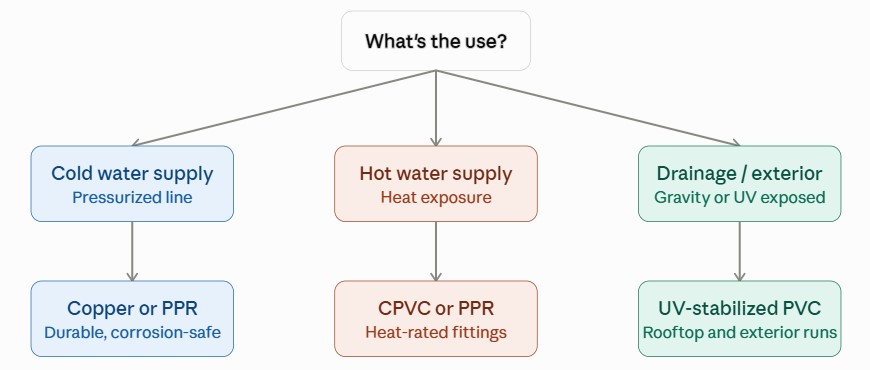
- PVC (Polyvinyl Chloride): The most widely used material for drainage, waste, and vent (DWV) systems in residential and light commercial projects due to low cost and corrosion resistance.
- CPVC (Chlorinated PVC): Used for hot and cold water supply lines where higher temperature tolerance is needed.
- Copper: Common in older buildings and premium installations for water supply, valued for durability and antimicrobial properties.
- PPR (Polypropylene Random Copolymer): Increasingly used in newer developments for both hot and cold supply due to heat resistance and leak-free heat-fusion joints.
- Galvanized Steel: Found mostly in legacy buildings; being phased out due to internal corrosion over time.
Essential Types of Plumbing Fittings
Elbows
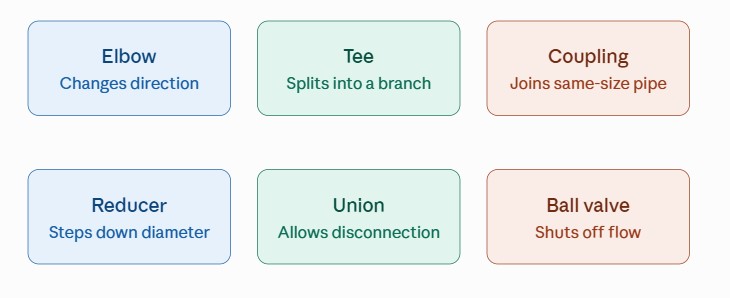
Elbows change the direction of pipe runs, typically at 45° or 90° angles, and are essential wherever pipework must navigate around structural walls, columns, or ceiling voids.
Tees
Tees split a single pipe run into two directions, commonly used where a branch line feeds a bathroom, kitchen sink, or secondary outlet from a main supply line.
Couplings
Couplings join two straight pipe sections of the same diameter, used to extend pipe runs or repair damaged sections without altering the flow path.
Reducers
Reducers connect pipes of different diameters, often used where a larger main supply line steps down to a smaller branch line serving individual fixtures.
Unions
Unions allow pipe sections to be disconnected without cutting, making them essential at points requiring future maintenance access, such as near water heaters or pumps.
Valves (Gate, Ball, Check)
Valves control or restrict water flow and prevent backflow, with ball valves commonly used for shut-off points and check valves protecting pumps from reverse flow.
Fittings for Water Supply vs. Drainage Systems
Fittings used for pressurized water supply differ significantly from those used for gravity-fed drainage.
| Function | Supply Line Fittings | Drainage Fittings |
| Pressure rating | High (rated PSI) | Low, gravity-based |
| Common material | Copper, PPR, CPVC | PVC |
| Joint type | Threaded, solvent-welded, or fusion | Solvent cement or push-fit |
| Typical fittings | Elbows, tees, unions, valves | Wyes, traps, cleanouts |
Wyes and traps are unique to drainage systems: wyes allow smooth-angle branch connections that reduce clogging, while traps (such as P-traps) retain a water seal that blocks sewer gases from entering living spaces.
Compliance Standards for Fittings in Malaysia
Plumbing fittings used in Malaysian construction should meet recognized quality and safety benchmarks before installation.
- SIRIM certification confirms that PVC and CPVC fittings meet Malaysian product safety and durability standards.
- Uniform Building By-Laws (UBBL) 1984 set out minimum requirements for sanitary plumbing and drainage in buildings.
- Indah Water Konsortium (IWK) guidelines govern connections to the national sewerage network for wastewater fittings.
- Fittings for gas or specialized commercial systems may additionally require sign-off from a registered Professional Engineer (PE).
Using uncertified fittings can result in failed inspections, insurance complications, or costly rework during handover of a completed property.
Choosing the Right Fitting for Your Project
When selecting plumbing fittings, consider the following factors and choose products from a reliable supplier such as Al Zafeer Building Materials:
- Match fitting material to existing pipe material to avoid galvanic corrosion
- Confirm pressure rating suits the supply line (mains vs. booster pump systems)
- Verify SIRIM certification on the packaging or datasheet
- Choose UV-stabilized PVC for any exposed rooftop or exterior runs
- Plan union placement near appliances requiring future servicing
- Account for thermal expansion on long horizontal hot water runs
Common Installation Mistakes to Avoid
- Mixing metal and plastic fittings without a dielectric union, accelerating corrosion at the joint
- Over-tightening threaded fittings, which cracks fitting bodies over time
- Skipping primer before PVC solvent welding, resulting in weak, leak-prone joints
- Ignoring slope requirements on drainage fittings, causing standing water and odor buildup
- Ignoring slope requirements on drainage fittings, causing standing water and odor buildup
FAQ
What is the most durable plumbing fitting material for Malaysian homes?
PPR and copper fittings generally offer the best long-term durability for water supply lines in Malaysia’s humid climate, while PVC remains the standard for drainage due to its corrosion resistance and low cost.
Do plumbing fittings in Malaysia need certification?
Yes. Fittings should carry SIRIM certification and comply with the Uniform Building By-Laws 1984 to pass inspection and ensure long-term safety in both residential and commercial installations.
Can PVC fittings be used for hot water lines?
Standard PVC is not rated for hot water and can deform under heat; CPVC or PPR fittings should be used instead for any hot water supply application.
Reliable Plumbing Fittings Supplier in Malaysia
Al Zafeer Building Materials supplies sanitary and plumbing products for residential, commercial and maintenance projects across Malaysia. Get the right fittings and plumbing supplies for your project from a reliable local supplier.